The Nevestrograd Compendium of Curious Happenings
Entry for 20 June 1848
Guard Duty
By D. Sionann Drevan
Entry the First: Aleksander the Prompt
Aleksander Vasilyev arrived early.
This was not strictly required. The order specified only that the post be manned “from the morning hours,” a phrase which, in practice, meant whatever it needed to mean. Still, Aleks preferred clarity where he could find it, and so he came while the light was still settling into the fields, before the road had quite remembered itself.
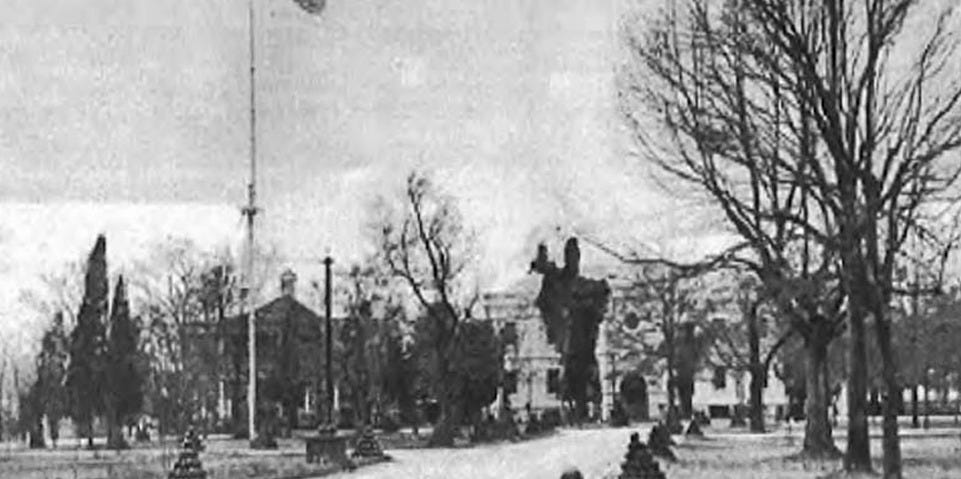
The flagpole stood where it always had—just beyond the last cluster of houses, where the town loosened its grip and became road. It was unremarkable: a straight wooden shaft, weathered but sound, planted beside a shallow ditch. No plaque. No fence. No explanation. The flag itself hung slack, its colors dulled slightly by sun and rain, though still correct, as far as Aleks knew.
He halted a pace before it and took stock.
The ground was dry. The rope intact. The knot, tied by his own hands two days earlier, held firm. He adjusted it anyway. Not because it was wrong, but because adjustment was part of attention, and attention was the substance of duty.
Aleks positioned himself where he could be seen from the bend in the road. Not too close to the pole, this was not veneration, but not so far as to suggest indifference. Hands clasped behind his back, spine straight, boots aligned with a precision that came as naturally to him as breathing.
Nothing happened.
A cart passed in the distance, its wheels rattling faintly. A bird crossed the sky without ceremony. Behind him, the town murmured in its habitual register: shutters opening, a door slamming, the distant argument of commerce warming itself for the day.
Turning would have suggested curiosity. He stayed where he was.
The instruction had been brief enough to memorize and vague enough to resist improvement. Presence, he understood, was not merely physical. It was a posture. A reassurance. A signal, however imprecise, that the state had not entirely withdrawn its attention from this place.
In another man, the thought might have provoked doubt. In Aleks, it produced resolve.
Order, in Aleks’s experience, rarely announced itself at all; it simply remained, and people calmed down around it without noticing why. Aleks had learned early on that explanations invited arguments, while silence usually passed inspection. A man standing where he had been told to stand, standing well, could quiet a great many anxieties without opening his mouth.
A woman approached from town, basket on her arm. She slowed when she saw him, then continued, nodding once in passing. Aleks returned the nod—neither stiffly nor familiarly. She did not look at the flagpole. Few did. That did not trouble him. People rarely noticed the things that steadied them.
He made a brief mental note—civilian demeanor: calm—and let it go. There would be time later to write it down, if necessary.
The sun climbed. Heat gathered itself in the grass. Aleks remained.
It was only after some time that he heard boots approaching with no particular respect for rhythm.
“Would you look at that,” came Norvik’s voice, broad and cheerful as a thrown arm. “Standing like the pole’s about to salute you.”
Aleks did not turn at once. He allowed himself the small dignity of finishing his observation—nothing amiss, nothing altered—before acknowledging the interruption.
“You’re late, Privates,” he said evenly.
Norvik Sidorenkov emerged into view, tall frame already loose with movement, uniform worn with a friendliness that bordered on defiance. His cap sat crooked. His grin was unrepentant.
“Not late, Lieutenant Vasilyev,” Norvik said. “I arrived exactly when I meant to.”
Behind him came Deividas Karpov, shorter, sharper, boots polished to a shine that suggested both pride and compensation. He paused a step back from the road, assessing the scene as though it were a stage he had not yet decided how to enter.
“Well,” Deividas said, “this is inspiring.”
Aleks turned then, fixing them both with a look that was not quite disapproval, but very much wished to be taken for it.
“This is an assignment,” he said. “Not a picnic.”
Norvik placed a hand over his heart. “Forgive us, Lieutenant. We didn’t realize the flag was in danger.”
“It’s always in danger,” Aleks replied, without humor. “From neglect, if nothing else.”
Deividas snorted softly. “Hear that, Norv? We’re guardians now. Custodians of cloth.”
Norvik nodded solemnly. “I’ll die for it,” he said. “But I’d prefer lunch first.”
Aleks sighed—quietly, the way one does when faced with inevitability—and returned his gaze to the road.
“Positions,” he said.
And, with the ease of long habit, they took them.
Entry the Second: Operation Observation
They stood.
This, it turned out, was the greater part of the assignment.
The road did not immediately justify their presence. It curved away with a kind of mild obstinacy, refusing to deliver either threat or novelty. Dust lay undisturbed. The ditch beside the pole held nothing more seditious than grass.
Aleks adjusted his stance, settling into a posture he could maintain indefinitely. Norvik, after a moment of earnest imitation, shifted his weight from one foot to the other, then back again, as though testing the ground for treachery.
Deividas squinted at the flag.
“How long has it been like that?” he asked.
“Like what?” Aleks said.
“Like… that,” Deividas replied, gesturing upward. “So still. It’s unsettling.”
“There’s no wind,” Aleks said.
“Or,” Deividas said thoughtfully, “the wind has decided not to participate.”
Norvik tilted his head back, following the line of the pole. “Looks fine to me. Proud. Upright. Like a man who’s finished his chores and is waiting to be told what they were for.”
Aleks ignored this.
Minutes passed. Or something like them.
A fly circled Norvik’s ear. He endured it for longer than expected, then swatted it away with an expression of betrayed patience.
“Do we… do anything?” Norvik asked.
“We observe,” Aleks said.
Norvik nodded. He observed with great intensity for several seconds, eyes sweeping the road, the field, the sky.
“I observe nothing,” he reported.
“That,” Aleks said, “is still an observation.”
Deividas leaned against the pole until Aleks cleared his throat, at which point Deividas straightened, hands raised in concession.
“Just seeing how it feels,” he said. “For morale.”
Aleks removed a folded paper from his pocket, smoothed it carefully, and consulted it despite knowing its contents by heart.
“Remain in place,” he read. “Maintain visibility. Monitor public mood.”
Norvik brightened. “Ah. Mood. I’m good with moods.”
“You are not to engage,” Aleks said.
“I wasn’t going to engage,” Norvik protested. “I was just going to… sense.”
Deividas clasped his hands behind his back in a parody of Aleks’s stance, chest out, chin high.
“How’s the mood now?” he asked, in a voice pitched for authority.
Aleks shot him a look.
Deividas dropped the act. “I’m only saying, if we’re meant to monitor it, it would help to know what it looks like when it’s misbehaving.”
Aleks hesitated. This was the trouble with vague orders: they invited philosophy.
“Mood,” he said finally, “is indicated by deviation.”
“From what?” Norvik asked.
Aleks opened his mouth. Closed it.
“From normal,” he said, with the faint air of a man disappointed by his own answer.
They stood again.
The sun climbed another imperceptible degree. Heat settled into the wood of the pole. The flag did not move.
Deividas counted his steps from the ditch to the road, then back again.
“Seven,” he said. “Same as yesterday.”
“Don’t pace,” Aleks said.
“I’m not pacing,” Deividas replied. “I’m confirming stability.”
Norvik cleared his throat. “Should we write something down?”
Aleks considered this.
“No,” he said. “Not yet.”
“How will we remember?” Norvik asked.
“We’re not meant to,” Aleks said, then paused. “Not all of it.”
This seemed to satisfy no one, but they accepted it.
Time continued in this fashion—present, unhelpful, vaguely accusatory.
At some point, Norvik said, “You ever think they put the pole here just to see if anyone would stand by it?”
“That’s not how assignments work,” Aleks said.
Norvik nodded, unconvinced. “Still. Someone had to be first.”
Deividas smiled faintly at this, eyes on the empty road.
“And someone,” he added, “has to keep being next.”
They fell silent again.
The flag flapped weakly in the breeze.
Entry the Third: Concerned Citizens
They were still standing—Aleks in deliberate stillness, Norvik in approximate stillness, Deividas in something that might charitably be called intention—when the two old women appeared together at the bend in the road.
This alone was cause for concern.
Babushka Valentina Kozlova, known locally as Baba Valya, advanced with her cane striking the dirt like punctuation. Babushka Galya Hryhorivna kept pace beside her, basket on one arm, crochet working steadily, her expression one of mild anticipation, as if she had been promised a story and meant to collect it.
They stopped directly in front of the flagpole.
Baba Valya looked at the soldiers.
Then at the flag.
Then back at the soldiers.
She clicked her tongue.
“This won’t do.”
Aleks straightened. “Good morning, Baba.”
“Morning,” Baba Valya said. “I’ve seen better ones.”
Norvik smiled, helplessly respectful. “Is something amiss?”
“Everything,” she said. “You’re slouching.”
“I am not slouching,” Aleks said, reflexively.
She ignored him and turned her cane on Deividas.
“And you—why are those so shiny?”
Deividas glanced down. “Regulation?”
“In my day, a man with shiny boots was either lying or leaving. Shiny boots this early means you haven’t done anything worth doing.”
“Oh, if the Tsar only knew…” Galya muttered.
Norvik snorted, caught himself. “With respect, Babas, we’re on duty.”
“On duty,” Baba Valya repeated. “Standing around a stick like it’s going to run away.”
Galya squinted up at the flag. “It might,” she said. “Things do.”
Aleks cleared his throat. “We are assigned to maintain the post.”
“And what post is that?” Galya asked.
“This one,” Aleks said, indicating the pole.
Galya nodded slowly. “Ah.”
She studied Aleks with sudden intensity.
“You know him, then?”
Aleks blinked. “Know who?”
“The Tsar,” Galya said. “Obviously.”
A brief silence followed, in which the road itself seemed to lean in.
“I—” Aleks began.
“You must,” Galya continued. “They wouldn’t put a boy who didn’t know the Tsar in charge of his stick.”
“It’s not—” Deividas tried.
Baba Valya rounded on Galya. “Don’t be foolish. He doesn’t know the Tsar. He just thinks he does.”
“I do not think I know the Tsar,” Aleks said carefully.
Galya waved this away. “Don’t get smart.”
She stepped closer, lowering her voice.
“When you see him next,” she said, “tell him the roads are cracking again.”
“Have they ever stopped?” Valya added, irritably.
“I don’t know the Tsar, ma’am,” Aleks said.
“Well, someone does,” Galya replied. “And they never tell him the useful things.”
Baba Valya sniffed. “If he listened to old women, the world would be quieter.”
“Or louder,” Norvik whispered to Deividas.
Baba Valya snapped her head back. “Stop slouching!”
Norvik straightened instantly.
“We are standing as instructed,” Aleks said.
“And who instructed you?” Baba Valya demanded.
Aleks hesitated—just long enough. “My superiors.”
“And who instructed them?”
“Their superiors, ma’am.”
“Only God is superior,” she said decisively.
Aleks faltered.
Norvik shifted. “If you’d like, we can stand… differently.”
Baba Valya eyed him. “I want you to stand properly. Not differently.”
“Not European,” Galya added, reaching into her basket and producing a boiled egg, turning it thoughtfully. “You boys eat?”
“Yes, ma’am,” Norvik said at once.
“Lies,” Baba Valya said. “They all lie.”
Galya nodded. “Thin faces. Government feeding.”
She pressed the egg into Norvik’s hand. He accepted it as if it were a medal.
“For morale,” she said. “You’re guarding moods, aren’t you?”
Aleks stiffened. “We are monitoring public mood.”
Baba Valya laughed, sharp and sudden. “Then write this down: the mood thinks you look ridiculous.”
Deividas bit his lip.
Galya leaned closer to Aleks. “And tell the Tsar there are subversives in Nevestrograd.”
“And Frenchmen,” Valya added.
“Don’t forget the Swedish spy,” Galya said, peeling another egg.
“Oh, Charles?” Norvik said, too cheerily.
“If that’s his name,” Valya said darkly.
“Never trust a Charles,” Galya agreed.
Aleks opened his mouth. Closed it. Nodded once.
“I will… remember that.”
Galya smiled, satisfied.
“May I have an egg, Baba Galya?” Deividas asked.
“No, brat,” Valya said, sharp as a bayonet.
She tapped her cane twice. “Come on. We’ve educated them enough for one morning.”
They walked off together, already arguing about whether flags were better with blessings or without.
The soldiers watched them go.
Norvik looked at the egg in his hand. “Do we log that?”
“No,” Aleks said.
Deividas exhaled. “I think we’ve been inspected.”
Aleks faced the road, posture immaculate, face faintly flushed.
“We remain,” he said.
The flag stirred once in a breath of wind, then fell still again.
And the post—important, unimpressed, and entirely unconvinced—continued to be guarded.
Entry the Fourth: Resumption of Order
They stood again.
This time, the standing required effort.
Norvik shifted first—only a fraction, hardly worth remarking—but Aleks noticed it immediately. The looseness had crept back into his shoulders, as though something previously held in place had been released without permission.
“Posture,” Aleks said, without turning.
Norvik straightened at once. “Yes, sir.”
Deividas cleared his throat and adjusted his own stance, aligning himself a shade too carefully, as if attempting to remember the exact angle of correctness rather than inhabit it.
The road remained unchanged.
The ditch, unimpressed.
The flag hung as before.
And yet.
Aleks found himself checking the rope again. It had not moved. The knot was sound. Still, he retied it, fingers slower than before, deliberate to the point of ceremony.
Behind him, Norvik stood very still, the boiled egg warm in his palm. He did not eat it. He did not pocket it. He simply held it, as one might hold an object whose purpose had not yet been clarified.
Deividas stared at the road with unusual restraint. He did not comment on the silence. This, in itself, was a deviation.
Aleks returned to his position.
“Resume observation,” he said.
They obeyed.
Minutes passed.
A breeze moved through the grass without touching the flag. Norvik glanced upward, then corrected himself, eyes forward again. Deividas clasped his hands behind his back, mimicking Aleks’s posture with less irony than before.
Aleks felt the faint, unwelcome sensation that something had been added to the post—nothing visible, nothing actionable, but present all the same, like a smell one could not quite place.
He resisted the urge to articulate it.
Norvik swallowed.
“Sir?” he said, softly.
Aleks did not look at him. “Yes.”
“Just confirming,” Norvik said. “We’re still… here.”
“Yes,” Aleks said.
“Good,” Norvik replied, and fell silent.
Deividas shifted his weight, then froze, as if caught in the act of thinking. He opened his mouth, closed it, then said instead, “Road’s quiet.”
“It often is,” Aleks said.
“Yes,” Deividas agreed. “I meant… particularly.”
Aleks chose not to pursue this distinction.
A cart passed in the distance. The driver did not slow. Did not nod. Did not look.
Aleks watched until it disappeared beyond the bend.
“Civilian demeanor?” Norvik ventured.
Aleks considered.
“Unremarkable,” he said.
They accepted this.
Time continued, though not quite as before. It seemed to hesitate now, advancing in smaller increments, as though uncertain it was still required.
Norvik adjusted his feet again. Aleks corrected him with a glance. Deividas scratched his nose, then stopped, hands returning to position with an exaggerated care that suggested apology rather than discipline.
The egg remained uneaten.
At last, Aleks removed the folded paper from his pocket. He held it for a moment, then returned it without opening it.
“There will be no report,” he said.
“Yes, sir,” Deividas said.
Norvik nodded.
They stood.
The flag stirred—just once, briefly—then settled again, as though having reconsidered.
No one commented on this.
And though nothing had changed that could be named, the post no longer felt quite as empty as it had that morning.
They remained.
Entry the Fifth: Passing Interest
The sound of voices reached them before the figures themselves — light, unhurried, threaded with laughter that suggested no particular urgency. Aleks noted it without turning. Norvik did not.
He straightened instinctively, shoulders broadening as though drawn upward by invisible strings. Deividas followed suit a beat later, chin lifting, boots aligning with an enthusiasm that bordered on aspiration.
Aleks felt it happen and resented it at once.
“Positions,” he said quietly.
They complied, though not without excess.
The small group emerged from the bend: four young women walking abreast, skirts brushing dust from the road, conversation moving easily among them. One — the Melnyk girl, if Aleks placed her correctly — was recounting something with her hands, fingers shaping the air as though the story required architecture. Her companion, darker-haired, listened with the exaggerated patience of someone waiting for the punchline to justify the buildup.
The other two, Aleks registered at once, were not so easily filed away.
Zofia Grabowska walked slightly apart, her attention divided between the road and some inward measure only she could hear. She carried herself without effort, hands folded loosely, expression open but reserved. When she glanced toward the soldiers, it was with polite curiosity rather than appraisal, as though noting a detail of the landscape newly installed.
Oleksa Tkachuka, daughter of town physician Dr. Stanislav Tkachuk, walked beside her, closer to the center of things — alert, amused, already aware she was being watched. Her gaze flicked from one uniform to the next and lingered, just long enough to be intentional.
“What are you guarding?” the Melnyk girl asked, stopping short.
Norvik answered at once. “The road.”
Deividas added, “The mood.”
Aleks shot them both a look.
“The post,” he said, evenly.
Oleksa smiled. “Which post?”
“This one,” Deividas said, gesturing with unnecessary breadth.
Zofia tilted her head slightly, eyes moving to the flagpole at last. She studied it — not the flag itself, but the rope, the knot, the way the wood had weathered unevenly, as though reading the history of the thing rather than its present function.
“It’s very still,” she said.
“Yes,” Aleks said. “We prefer it that way.”
“Do you?” Oleksa asked. “Is there a danger of it running away?”
“These are uncertain times, ma’am,” Aleks said, a smile escaping despite himself.
Zofia’s expression shifted, not to alarm, but to something more considered. “Indeed. My brother says France went from revolution to massacre in under six months. And that horror in Austria.” She paused, then added, more quietly, “Though I wonder whether George is disturbed by the violence, or by how quickly everyone stopped being disturbed by it.”
The remark landed in the silence between them like a stone dropped into still water.
Oleksa glanced at her friend. “I heard about Paris. Dreadful business.”
“It is a nervous time for many,” Aleks said, his smile gone entirely.
He felt the conversation tipping toward something heavier than a roadside encounter warranted. “But the post remains secure,” he added, with a slight inclination toward the flag.
Norvik nodded eagerly. “Very secure. Dangerous work, really.”
“Dangerous,” Deividas added, with a confidence unsupported by evidence.
The Melnyk girl suppressed a laugh. Her darker-haired companion did not bother suppressing hers.
Zofia’s smile was gentler, but her eyes held the flagpole a moment longer, as though she had seen something in the stillness of it that the soldiers themselves had not considered.
“Well,” she said, “I’m glad someone is watching.”
Aleks inclined his head, not stiffly, not familiarly. “That is our intention.”
Oleksa looked at him then, properly, as if something had come into focus. For a brief moment, her expression shifted — curiosity sharpened by recognition, though of what, neither of them could have said.
“Good,” she said. “It would be a shame to miss something.”
“Perhaps we will see you at Kupala!” Deividas hollered after them, hope evident in his voice.
They moved on, laughter resuming as if uninterrupted. Dust settled behind them. The road reclaimed its shape.
Norvik exhaled. Deividas adjusted his collar, then his cuffs, then stopped adjusting altogether.
Aleks returned his gaze to the bend in the road.
“Positions,” he said again.
They stood.
And whatever had passed among them — interest, embarrassment, possibility — was not remarked upon, noted, or recorded.
The flag remained unmoved.
Entry the Sixth: A Familiar Stranger
They had returned to standing.
Norvik had only just finished arranging his face into something resembling seriousness when he saw them coming—two figures approaching at an angle that suggested neither urgency nor respect for the post.
Ivandel Viaclovsky walked with his hands clasped loosely behind his back, hat tilted at a thoughtful slant, coat unbuttoned despite the hour. Beside him, Mister Jacq Chandonnet sauntered with deliberate casualness, eyes already scanning the scene with the irreverence of a man who had survived Paris.
Norvik stiffened. Deividas did not.
Aleks felt it before he saw them.
He straightened—not for display this time, but necessity. Something tightened behind his ribs, a reflex he had long ago trained himself not to examine.
Ivandel stopped first.
“Well,” he said mildly, as if greeting a garden ornament. “If it isn’t civic virtue incarnate.”
Jacqs glanced around. “Road looks secure.”
“We are on duty,” Aleks said at once.
Ivandel’s gaze moved to him then—unhurried, exact. It lingered a fraction longer than politeness required, as though checking an old measurement against a new one.
“Of course you are, Aleksander Andreyevich,” Ivandel said. “You always are.”
There was no mockery in his voice. That, somehow, made it worse.
“Lieutenant Vasilyev,” Aleks corrected coolly.
Norvik cleared his throat. “Afternoon, citizens.”
“Is it?” Jacqs asked, squinting at the sky. “Time’s been behaving oddly.”
“We’re monitoring public mood,” Deividas said, attempting neutrality and achieving none.
Ivandel smiled faintly. “Ah.”
He stepped closer to the flagpole and circled it once, hands still folded, like a man inspecting a relic whose purpose had been lost to history.
“And how is the public mood this day?” he asked.
Aleks did not answer immediately. He was acutely aware of the exact distance between them.
“Unremarkable,” he said at last.
“Ah,” Ivan said, gaze shifting between the soldiers, “there is a thin line between stability and boredom, isn’t there?”
Before the air could tighten further, Deividas brightened. “Hold on—is this the famous Frenchman?”
Norvik leaned forward. “Monsieur Chandonnet, in the flesh!”
Jacqs bowed with theatrical courtesy. “Guilty, though my verses stayed in Paris.”
“Your poem The Lake,” Norvik said earnestly. “Changed my life.”
“A fine piece,” Jacqs said, amused. “Lamartine wrote it.”
Norvik blinked. “Ah.”
Deividas rallied. “Then The Barber of Seville—brilliant satire!”
Jacqs let out a pained laugh. “Beaumarchais, my dear boy. Long before my time. But thank you for the promotion.”
Aleks cleared his throat, attempting to restore order. “Welcome to Nevestrograd, monsieur. We’ll endeavor to keep our references straight.”
Ivandel clapped Jacqs lightly on the shoulder. “Don’t feel bad, comrade, I doubt they could name one of my poems either.”
Norvik laughed. “Let’s be honest, Private Karpov’s only verse is tavern songs!”
Deividas crossed his arms. “I know plenty—just not his.”
Aleks hesitated, then spoke, staring down the road:
“Through seas and lands so wide I tread with steadfast grace—
Not for the fierce critics who chase their eager gain.
I seek a single heart that treasures every phrase,
And trusts to love’s sweet art beyond all loss and pain.”
Birdsong filled the pause.
Ivandel blinked, expression unreadable.
Aleks shifted, almost defensive. “I found it in a journal,” he said. “It stayed with me.”
Ivandel inclined his head once, almost shyly.
For a moment it seemed he might speak. Instead, he glanced down the road, then back toward town, expression shuttering.
“Come along,” he said to Jacqs. “Before we’re accused of loitering with intent.”
Jacqs offered a lazy salute. “Keep up the good work, gentlemen. Wouldn’t want anything… happening.”
They moved on, neither man looking back.
Entry the Seventh: Official Interest
They had resumed standing.
Not convincingly.
Norvik had drifted a half-step out of alignment. Deividas was counting something—stones, breaths, regrets. Aleks corrected them without comment, restoring the geometry of duty by force of habit alone.
It was then that Town Governor Viktor Grigoryevich Borisov appeared, advancing along the road with the steady inevitability of a scheduled eclipse.
He stopped precisely where one might expect a man like him to stop.
The pocket watch emerged. Opened. Consulted. Closed.
“Good,” he said, in a voice devoid of temperature. “You are present.”
“Yes, sir,” Aleks said at once.
Borisov regarded the flagpole. He regarded the road. He regarded the soldiers. His gaze lingered on each as though awaiting a confession.
“What,” he asked, “are you guarding?”
Aleks opened his mouth.
The Governor raised a hand—not sharply, merely efficiently. “No elaboration required. I can see it.”
He nodded once, satisfied.
“This post is… symbolically adequate,” Borisov continued. “Its visibility is reassuring. Its function is—” he paused, glancing at the pole again, “—theoretical.”
Norvik stiffened. Deividas swallowed.
Borisov adjusted his coat. “Public mood?”
“Unremarkable,” Aleks said.
“Excellent,” the Governor replied. “Unremarkable moods are the foundation of civil order.”
He turned to leave, then stopped.
“For the record,” he added, without turning, “you are performing this duty… impeccably.”
Then he walked on, punctual to the minute.
The road fell silent again.
Norvik blinked. “Did we just get praised?”
Deividas frowned. “I feel… validated. I don’t like it.”
Aleks said nothing.
He faced forward.
The flag hung.
The road forgot them.
Entry the Eighth: Relief
Relief arrived without ceremony.
Two soldiers appeared from the direction of town, boots in tolerable order, expressions already set to the neutral expectancy of men who had been told where to stand and had not yet asked why. They slowed as they approached the flagpole, eyes flicking briefly to the road, then to Aleks, awaiting instruction.
Aleks stepped forward.
He drew himself up, posture precise, hands clasped behind his back. Habit asserted itself at once.
“This post,” he began, “has remained—”
He stopped.
The words did not present themselves.
Norvik shifted behind him. Deividas coughed, softly, as if to offer punctuation.
Aleks glanced at the flagpole. The rope. The ditch. The road, which looked no different than it had that morning, or the morning before that, or any other morning he could recall.
“There has been,” he said carefully, “no incident.”
The new soldiers nodded, absorbing this with the seriousness it deserved.
“Public mood,” Aleks continued, then paused again. He considered. “Unremarkable.”
Another nod.
“The flag,” he added, after a moment, “has not moved.”
This, too, was accepted.
Aleks inclined his head, stepped aside, and gestured to the space they now vacated. The new guards took their places at once—one a little too close to the pole, the other a fraction too far—already approximating the geometry of duty.
Norvik hesitated, then stepped forward and held out the boiled egg.
The nearer guard accepted it without comment, turning it once in his palm as if this, too, were part of the post.
Norvik nodded, satisfied, and stepped back.
Deividas flexed his shoulders, then stopped himself, remembering where he was, and relaxed anyway.
The three of them walked back toward town together, boots finding their old, familiar rhythm. No one spoke. There was nothing left to clarify.
Behind them, the flag hung, as it had that morning.
The road wandered on. And Nevestrograd, having borrowed their attention for a time, returned it without comment.
Кінець.