

The Nevestrograd Compendium of Curious Happenings
Entry for 19 June 1848
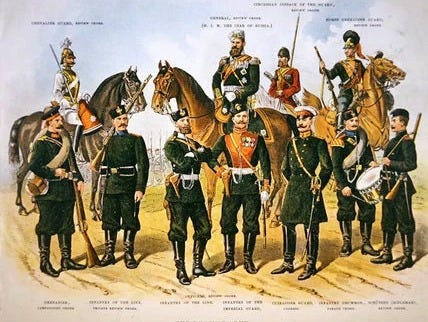
On the Present Disposition of the Imperial Army
The Russian Army, in the present year, remains less an instrument of novelty than a monument to persistence. It is vast, obedient, and slow to change—qualities regarded by its architects not as defects, but as proofs of seriousness.
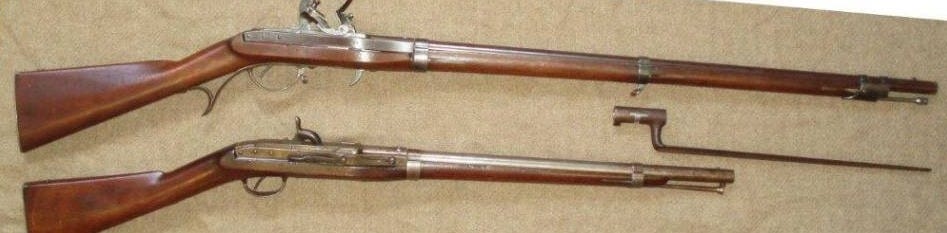
Its strength lies not in invention but in repetition. The infantryman is trained to stand, to advance, and to obey, in that order. His musket is heavy, inaccurate, and trusted chiefly as a carrier for the bayonet, which the Empire continues to regard as the most honest of arguments. Fire is preparatory. Steel is decisive.
Innovation has been observed elsewhere and found wanting. While foreign powers experiment with rifling and clever mechanisms, Russia invests instead in numbers, discipline, and the conviction that resolve, once massed, outweighs precision. Accuracy is admired. Endurance is relied upon.
Cavalry retains its ceremonial terror. Sabers flash, lances bristle, and horses are asked to believe in courage. Artillery speaks rarely but with authority, favoring simple iron conclusions over elaborate persuasion.
The Army’s true genius, if such a word may be permitted, is psychological. It advances not to surprise, but to convince—of inevitability, of weight, of the futility of resistance. It does not hurry. History, it assumes, will wait.
Thus in 1848, while Europe debates liberty and reforms itself loudly, the Russian Army stands prepared to restore order by standing still, and then moving forward together.
Whether this constitutes strength or merely confidence remains, as ever, a question deferred.
Hot Shots
By D. Sionann Drevan
Entry the First: Boys Will Be Boys
The edge of town sloped away into scrub grass and thistle, the land there giving up on usefulness and deciding instead to bask. June had settled in comfortably, sleeves rolled, the sun hanging low and indulgent, as if it planned to stay all afternoon and charge rent.
Three soldiers had claimed a patch of it for themselves.
Lieutenant Aleksander Vasilyev stood with the easy authority of a man who never slouched, even when no one was watching. His jacket lay folded on a rock behind him, his shirt sleeves rolled with military neatness that somehow survived leisure. He squinted at the target—an old crate lid nailed to a post—and exhaled slowly, as though the entire field might benefit from his calm.
Private Norvik Sidorenkov lounged a few paces back, sitting on an overturned bucket, boots planted wide, chewing something unidentifiable with heroic commitment. He was meant to be keeping score but had already lost track, twice, and was now improvising rules with the enthusiasm of a man who believed fairness was largely theoretical.
Private Deividas Karpov hovered near the rifles like a man choosing a dance partner, swaggering despite the fact that the grass nearly reached his knees. His uniform was immaculate, his boots polished to a mirror shine wholly inappropriate for dirt, and his expression suggested that whatever happened next would be impressive—if not necessarily successful.
“Right,” Deividas announced, clapping his hands. “Observe closely. This next one is for history.”
“That’s what you said last time,” Norvik said. “And the time before that. And the time you nearly shot the post.”
“Well, it’s all technically history, isn’t it, Private Sidorenkov?” Deividas replied. “Besides, that was a warning shot.”
“For the post?” Norvik asked.
“For the post,” Deividas said solemnly.
Aleks smiled despite himself. “Just aim before you declare victory.”
“Why bother shooting at all,” Deividas said, setting the rifle down with a grin, “when the outcome is already settled?”
“Take the shot, you daft turnip,” Norvik said.
“That’s Private Daft Turnip to you,” Deividas replied, “and besides—that is not what your sister calls me.”
Norvik opened his mouth, thought better of it, and instead made a vague choking sound.
Deividas lifted the rifle again with exaggerated care, feet planted far wider than necessary. He squinted down the barrel, tongue peeking out in concentration, then jerked the trigger with all the subtlety of a man swatting a wasp.
The shot cracked. A bird burst from the brush in furious indignation. The crate lid shuddered, unharmed, as if insulted by the attempt.
Norvik burst out laughing, a full-bodied sound that startled the grass. “You scared it! That’s something.”
“I was accounting for wind,” Deividas said.
“There is no wind,” Aleks said gently. “Except what’s coming out of you.”
“Ah,” Deividas replied. “That’s what makes it treacherous.”
Aleks stepped forward then, took the rifle without ceremony, adjusted his stance by a hair’s breadth. He breathed in, out. The shot was clean. The crate lid bore a neat hole just left of center.
Norvik whistled. “See? That’s how you talk to wood.”
Aleks shrugged, already handing the rifle back. “Luck.”
“Luck has posture now?” Deividas muttered.
They reset the target, argued about distances, debated whether Norvik’s earlier shot should count symbolically, and generally behaved like men who believed the world was forgiving and would remain so indefinitely.
Somewhere beyond them, Nevestrograd dozed—church bells idle, chimneys thinking about supper, the long afternoon stretching its legs.
None of them noticed the road just yet.
Entry the Second: Lavrenti Stays Sharp
The road made itself known not by sound so much as by interruption.
Aleksander noticed first, his attention drawn less by movement than by a sudden disturbance in the easy balance of the afternoon. Norvik followed his gaze a moment later. Deividas, still studying the target as if it might yet apologize, turned last.
Lavrenti Sergeyevich Driskovetz approached with quick, economical steps, as though the distance between himself and his destination were an inconvenience imposed upon him personally. His coat was buttoned too tightly for the warmth of the day, his hat pulled low, his thin face set in an expression of weary offense, as though he had been compelled to participate in a conversation already beneath him.
“So,” he said, arriving among them without greeting. “This is where the army has stationed itself.”
“Good afternoon, Well Born Driskovetz,” Aleks said, with the easy courtesy he extended even to those who did not invite it. “Enjoying the day?”
Lavrenti snorted. “The day is enjoying itself. I am merely enduring it.” His eyes flicked to the rifles, the target, the scattered paraphernalia of leisure. “I assume this is some sanctioned exercise in preparedness.”
“It is,” Aleks replied. “Of an informal nature.”
“Hm.” Lavrenti sniffed. “Informality is how empires rot.”
Deividas cleared his throat. “Care to join us, sir?”
The question hung there, awkward but sincere. Lavrenti looked genuinely surprised to have been invited. He glanced from face to face, suspicious of kindness, then back at the target.
“I don’t make a habit of indulging in recreational violence,” he said. “It cheapens the thing.”
“Right,” Norvik said. “Course.”
Driskovetz took a step closer all the same. “That said, forgetting how to handle such things is a different sort of irresponsibility.”
He stopped beside the rifles but did not touch them at once. He looked at them with the faint disapproval one reserves for tools improperly stored.
“How far?” he asked.
Aleks told him.
Driskovetz nodded. “Near enough to flatter the careless.”
Deividas smiled nervously. “She has a bit of a kick.”
Driskovetz looked at him then—briefly, sharply, without malice. “So does most reality.”
He took the rifle. There was no display of adjustment, no visible preparation. He shifted the sling slightly, more by habit than intention, and raised the weapon with the ease of a man returning an object to its proper place.
What struck the soldiers was not his confidence, but his lack of distraction. His body, which in conversation seemed perpetually at odds with itself, grew suddenly still, as though relieved to be required for only one purpose.
He fired once.
The sound was ordinary. The effect was not.
The crate lid bore a clean hole, placed with sufficient precision to make any discussion of chance feel beside the point.
Driskovetz lowered the rifle at once and handed it back to Aleksander.
“That will suffice,” he said. “The mechanism works. The system serves.”
Norvik looked at the target, then at Driskovetz, then back again, as though expecting some further explanation.
“Well,” he said finally.
Deividas swallowed. “You were trained, then?”
Driskovetz paused, just long enough for the question to acquire weight.
“I was,” he said. “At a time when one learned such things for reasons that were not explained.”
Aleks inclined his head. “Thank you, sir.”
Driskovetz adjusted his coat, already preparing himself to depart. “Enjoy this while it lasts,” he said. “Youth is spent lavishly, whether one means to or not.”
He turned back to the road and continued on, his muttering soon indistinguishable from the ordinary grievances of the world.
The three soldiers stood for a moment without speaking.
“I don’t care for him,” Deividas said at last.
“Does anyone?” Norvik agreed.
“His mother. Maybe?”
Aleks looked once more at the target, then down the road where Driskovetz had gone. “Still,” he said quietly, “he is not a careless man.”
And the afternoon, which had tolerated everything so far, resumed its calm.
Entry the Third: Matters of the Heart (Discussed Improperly)
They were still standing there when the laughter returned—not all at once, but cautiously, like a conversation restarting after someone important has left the room.
Norvik was the first to break the silence, nudging the crate lid with his boot. “Well,” he said, “that was invigorating. Nothing like a surprise lecture in mortality to sharpen the afternoon.”
Deividas snorted. “I don’t care what anyone says. He shoots like a man who files complaints in advance.”
Aleks smiled, but his attention had drifted. He was watching the road again, though it was empty now, the disturbance absorbed back into the ordinary afternoon.
Norvik followed his gaze and grinned. “You know,” he said, with studied casualness, “my mother asked about you again.”
Aleks groaned softly. “Your mother asks about everyone.”
“Yes,” Norvik agreed. “But she hopes for you.”
Deividas perked up at once. “Ah. Our golden boy.” He leaned against the post, arms folded. “Twenty-six, a lieutenant, good family, respectable income, face like it was approved by committee. And still unmarried.”
Aleks raised an eyebrow. “Is this an intervention?”
“More of an investigation,” Deividas said. “The town is beginning to suspect you’re hiding something.”
“I’m hiding from something,” Aleks replied mildly.
Norvik laughed. “You’ve had half of Nevestrograd ready to throw themselves at you. What are you waiting for?”
Aleks considered this. “Something that doesn’t feel like a transaction.”
The words landed more heavily than he seemed to intend. Deividas blinked. Norvik scratched his chin.
“Well,” Norvik said at last, “that’s inconvenient.”
“It is,” Aleks agreed.
Deividas recovered quickly. “You see, Norv? That’s what refinement does to a man. Ruins him for perfectly good arrangements.”
“Oh, please,” Norvik said. “Says the man who calls himself The Grand Seducer and has yet to produce so much as a handkerchief in proof.”
Deividas straightened. “I choose my opportunities carefully.”
“You trip over them,” Norvik said. “Usually while retreating.”
“At least I’m not being managed,” Deividas shot back.
Norvik’s grin widened. “Ah. You mean Dibiasia.”
Deividas winced theatrically. “I’ve seen how she looks at you. Like a general inspecting a horse before purchase.”
Norvik shrugged, entirely unbothered. “Well, Private, some of us are horses.”
“A horse’s hindquarters, maybe.”
Norvik laughed. “Strong back. Good teeth. You, on the other hand—you’d be one of those miniature horses. What are they called?”
Aleks didn’t miss a beat. “A pony.”
Deividas stared at them both, then shook his head. “Ah, yes. Now I remember—that is what your sister called me, because—”
“Don’t,” Norvik said, the grin gone. “You won’t finish that sentence.”
Deividas opened his mouth, then closed it. “Still,” he said, regrouping, “at least I’m not already henpecked.”
Norvik laughed. “Henpecked? She’d never waste the energy. She just tells me what’s happening.”
Aleks chuckled despite himself. “And you listen.”
“Of course I do,” Norvik said. “I’m not a fool.”
They stood there a moment longer, the target forgotten, the rifles cooling in the grass. Somewhere, a bell rang—distant, domestic, unconcerned with their troubles.
Deividas broke the silence again, more quietly this time. “So,” he said to Aleks. “If not marriage… what, then?”
Aleks thought of the road, of the stillness that had passed through them, of expectations that felt heavier the more carefully they were handled. He looked away, toward the empty stretch where Driskovetz had disappeared. “I suppose,” he said slowly, “I’m waiting to know what I’d be promising.”
Norvik nodded, uncharacteristically thoughtful. “Fair enough.”
Deividas sighed. “Tragic,” he said. “All of you. I, meanwhile, remain gloriously unattached.”
Norvik clapped him on the shoulder. “Unattached implies interest.”
Deividas brushed him off. “Give it time, good lads. I am like a fine Kulebyaka. Takes a while to appreciate all my layers. Complex, me.”
Norvik hooted. “No, comrade—you have a complex. Very different thing.”
The afternoon, having tested them in small ways, seemed satisfied. It stretched again, indulgent as before, letting the boys talk themselves back into laughter.
And Nevestrograd, which had been listening all along, kept its counsel.
Кінець.

On Ordinary Men, Temporarily Paused
Nothing important happens here.
No orders are given.
No borders shift.
No history is impressed.
Three young men stand in grass
and talk themselves out of seriousness.
A bureaucrat fires once
and walks away.
A bell rings.
The afternoon survives.
And yet.
This is where the story lives.
In the pauses between usefulness.
In the way a rifle cools.
In the way a joke hides a hesitation.
In how a man admits, carefully,
that he does not yet know
what kind of life he is willing to promise.
Empires fall in ledgers and speeches.
They are built
in moments like this.
Where people practice being human
before they are asked to be brave.
Where kindness is unremarkable.
Where fear is laughed at gently.
Where loyalty has not yet been tested
and therefore still feels infinite.
Driskovetz passes through
like a reminder of what time does.
The boys remain
like evidence of what it has not yet taken.
They are not heroes.
Not yet.
They are apprentices to living.
Learning how to disagree without cruelty.
How to admire without surrender.
How to wait without rotting.
Some of them will fail.
Some will grow careful.
Some will grow hard.
But here, for now,
they are intact.
And the city listens.
Because this is how history begins:
Not with declarations.
With afternoons
that quietly decide
what kind of men
will be available
when the world asks too much.